Dog Car Seat Cover With Side Protection: A Zone-by-Zone Setup Guide
A dog car seat cover with side protection is not simply a larger bench cover. It makes a specific choice about where travel messes and restless movement tend to spread: toward the doors, the front-seat backs, and the gap between the rear bench and the floor. Reading those areas separately is more useful than assuming that “full coverage” means the same thing in every car.

A coverage map, rather than a “full coverage” claim
SafiPet’s Modular Hard Bottom Extender Car Seat Cover pairs a rigid honeycomb-supported platform with zip-up side panels. The table separates the stated construction from what a buyer should assess in their own vehicle.
| Area of the rear seat | Verified product detail | Decision question |
|---|---|---|
| Bench and footwell bridge | Rigid honeycomb panels create a stable, supportive platform. | Does your dog need a flatter resting surface than a standard hanging hammock provides? |
| Door-side edge | Zip-up side panels are designed to help protect seats, doors, and seat backs from hair, dirt, and everyday wear. | Is the door-side upholstery a routine cleanup concern when your dog enters, turns, or settles? |
| Front-seat backs | Adjustable straps and extended coverage are part of the installation. | Can the straps be positioned cleanly around your headrests without interfering with your vehicle’s features? |
| Cabin view and airflow | A mesh window is designed to support airflow and give the dog a view toward the front cabin. | Will a visible front-cabin connection suit your dog’s travel behavior? |
| Restraint access | Dedicated openings provide access for compatible pet restraints. | Have you chosen and correctly fitted a separate vehicle-appropriate pet restraint? |
What the side panels change in daily use
Side panels can be valuable when the mess is not confined to the center of the seat. A wet dog does not stay in one square of fabric: paws meet the door-side edge when climbing in, the dog may lean toward a window, and a turn on the bench can put hair and grit against the side upholstery. The side panels on this design are intended to extend the protective surface into those areas.
They also introduce a practical routine. Zip the panels up when you want that surrounding coverage; open or lower them deliberately when you need an easier entry path. That is a usability decision, not a safety feature. A cover cannot replace a vehicle-approved pet restraint, and the product’s restraint openings exist only to give access to a compatible restraint system.
Hard bottom and side protection solve different problems
It is easy to bundle every feature under “comfort,” but the construction has two distinct jobs. The hard-bottom extender addresses the shape of the space between the rear bench and the front seats. The side panels address the edges of that space. A dog that is content on a hammock may still benefit from door-side protection; a dog that needs a more level rest area may care more about the supported platform. Separating the two lets you avoid buying extra material for the wrong reason.
The cover’s PE support panels, adjustable straps, seat anchors, and textured backing are designed to help reduce movement during normal driving when properly installed. That is not a claim that the cover itself restrains a pet, guarantees a fit in every vehicle, or remains fixed under every driving condition.
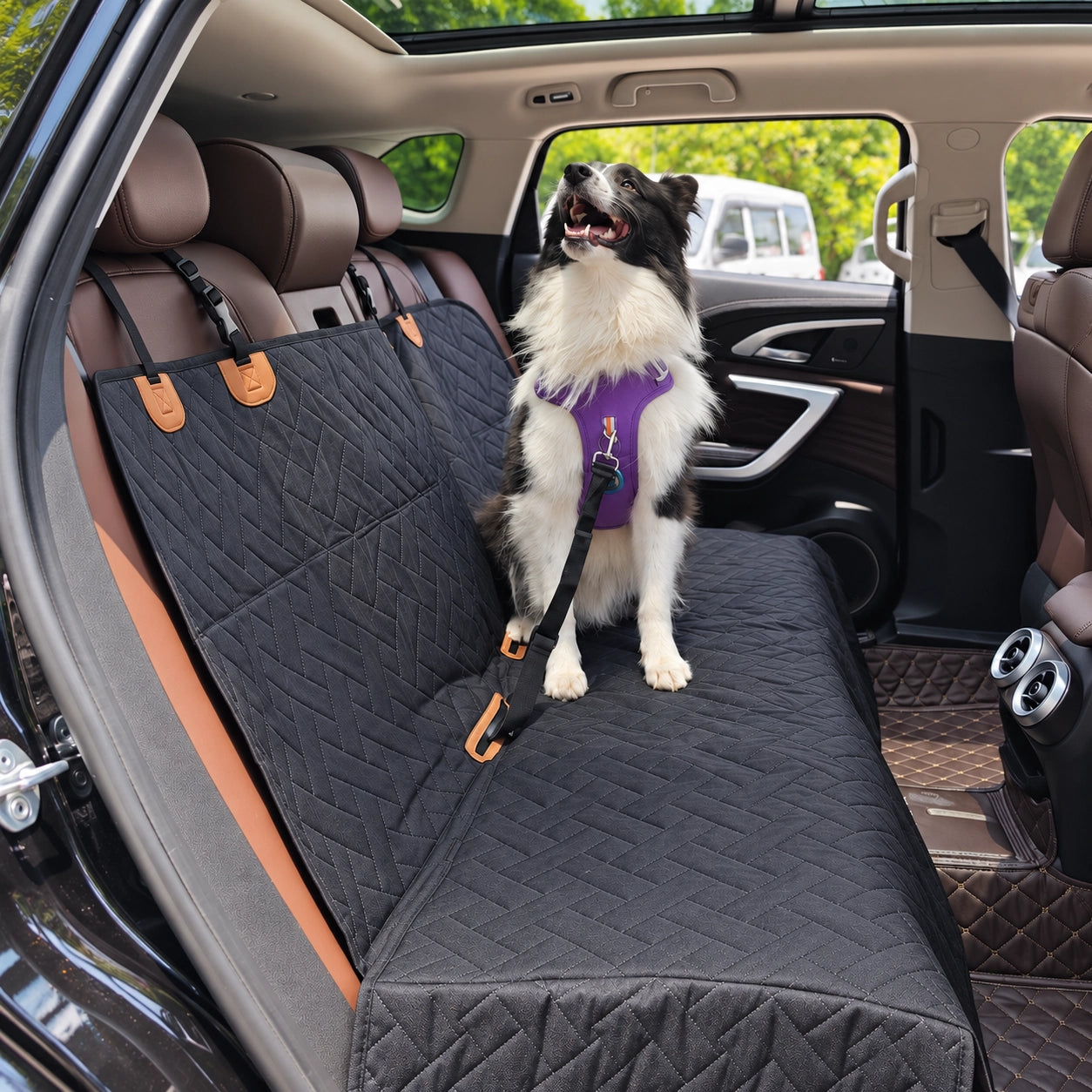
Use the RAV4 photo as evidence—carefully
The first-party installation image above is useful because it makes the coverage boundaries visible: the back-seat area is extended forward, the side protection rises toward the door openings, and the dog retains a broad rear-seat area. It does not establish a size rule for every RAV4 model year, every dog, or every vehicle. Before buying, compare your rear-seat dimensions, headrest layout, and door clearance with the product information, then install and inspect the setup while parked.
A short parked-car check before the first trip
- Attach the straps, anchors, and support panels exactly as directed; confirm that the platform is seated evenly.
- Zip the side panels and open both rear doors to verify that no material is pinched and that your dog has a sensible entry route.
- With your dog supervised in the parked car, check normal lying, turning, and standing positions rather than judging fit from a product photo.
- Use a compatible pet restraint through the access opening if appropriate; the cover itself is not a substitute for one.
For a broader comparison of supported rear-seat layouts, see our hard-bottom dog back seat extender guide. The aim is not the largest possible cover; it is a setup whose protection zones match the places your dog actually uses.